SY-F100
指套式多参数记录仪
Finger-sleeve Multimodal Monitor
指端是外周生理信号保真度最高的观测位点。SY-F100 在单指上同时完成 ECG、多波长 PPG、EDA 三模态同步采集,并集成振动刺激模块用于大纤维功能检测。三大部分构成整机:指套硬件终端、嵌入式控制软件、数据接收端软件。 The fingertip offers the highest-fidelity observation site for peripheral physiology. SY-F100 performs synchronous ECG, multi-wavelength PPG and EDA acquisition on a single finger, and integrates a vibration module for large-fibre assessment. The system comprises three parts: the finger-sleeve terminal, embedded control software and data-receiver software.
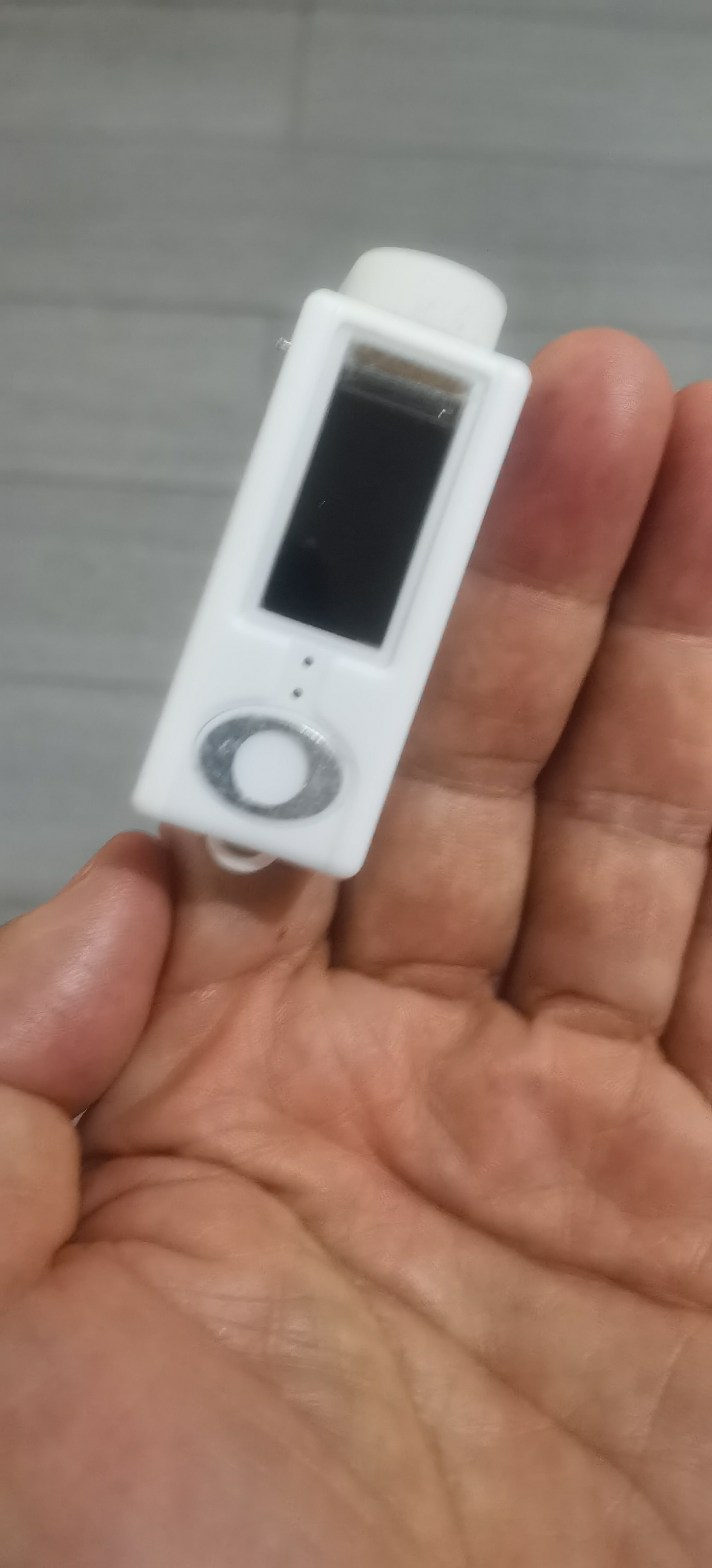
工程样机实物(白壳工程版) Engineering-sample unit (white-shell engineering build)
型号规格Model specifications
- 产品名称Product name 指套式多参数记录仪Finger-sleeve Multimodal Monitor
- 型号ModelSY-F100
- 管理类别Regulatory class 第二类有源医疗器械Class II active device
- 分类编码Classification code 07-04 生理参数监护设备Physiological monitoring
- 尺寸 (L×W×H)Dimensions58 × 42 × 28 mm
- 重量Weight ≈ 28 g(含电池)≈ 28 g incl. battery
- 电池Battery 3.7 V Li-Po, ≥220 mAh
- 续航Runtime ≥24 h 连续采集≥24 h continuous
- 防水等级Ingress protection IP22
01 整机结构组成Device Structure
三大部分:硬件终端 + 嵌入式软件 + 接收端 Three parts: terminal + embedded software + receiver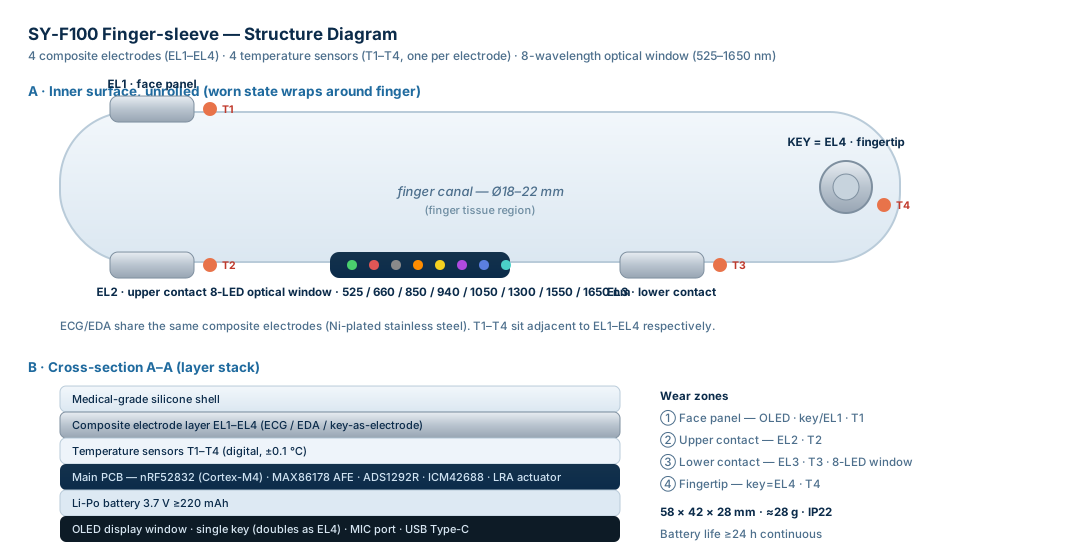
整机结构图:四个复合电极(EL1–EL4)沿指周分布,每个电极旁各一路温度传感器(T1–T4);8 波长光学窗位于下接触区;按键兼作 EL4。点击查看大图。 Structure diagram: four composite electrodes (EL1–EL4) distributed around the finger, one temperature sensor (T1–T4) adjacent to each; the 8-wavelength optical window sits in the lower contact zone; the key doubles as EL4. Open full size.
指套硬件终端 · 元器件清单 Finger-sleeve terminal · component list
| # | 部件Component | 规格 / 型号Specification |
|---|---|---|
| 3.2.1 | 主控 MCUMain MCU | 低功耗 32 位 ARM Cortex-M4Low-power 32-bit ARM Cortex-M4 |
| 3.2.2 | ECG 采集模块ECG front-end | MAX86178(模式 1mode 1) |
| 3.2.3 | EDA 采集模块EDA front-end | MAX86178(模式 2mode 2) |
| 3.2.4 | PPG 采集模块PPG front-end | 多波长光学传感器Multi-wavelength optical sensor |
| 3.2.5 | 复合电极 ×4Composite electrodes ×4 | 不锈钢镀镍金属贴片(ECG/EDA 共用),4 个电极沿指周均匀分布Nickel-plated stainless steel (ECG/EDA shared), four electrodes distributed evenly around the finger |
| 3.2.6 | 温度传感器 ×4Temperature ×4 | 数字式 ±0.1 ℃,每个电极附近各 1 路Digital, ±0.1 ℃, one adjacent to each electrode |
| 3.2.7 | 六轴 IMU6-axis IMU | ICM42688 |
| 3.2.8 | 振动输出模块Vibration module | 线性谐振执行器(可选:仅作激励源)Linear resonant actuator (option:excitation only) |
| 3.2.9 | 无线通信Wireless | 低功耗蓝牙 5.0Bluetooth Low Energy 5.0 |
| 3.2.10 | 供电电池Battery | 3.7 V Li-Po, ≥220 mAh |
| 3.2.11 | 指套结构Sleeve structure | 医用级柔性硅胶Medical-grade flexible silicone |
分层结构 · 佩戴分区 Layered structure · wear zones
- 面板Face panel — OLED 显示屏 · 触摸按键 · ECG/EDA 电极(EL1)· MIC 采集孔 · 温度采集(T1) OLED display · touch key · ECG/EDA electrode (EL1) · MIC port · temperature sensing (T1)
- 主体(主板)Main body (mainboard) — 主控 · USB(充电 / U 盘)· 2×PD · 电池 · ECG/EDA 按键 MCU · USB (charging / mass storage) · 2×PD · battery · ECG/EDA key
- 上接触区Upper contact zone — 硅胶 · 电极 EL2 · 温度采集(T2) Silicone · electrode EL2 · temperature sensing (T2)
- 下接触区Lower contact zone — 硅胶 · 电极 EL3 · 温度采集(T3)· 8 个 LED(多波长 PPG) Silicone · electrode EL3 · temperature sensing (T3) · 8 LEDs (multi-wavelength PPG)
- 指尖区Fingertip zone — ECG/EDA 按键兼电极 EL4 · 温度采集(T4) ECG/EDA key doubling as electrode EL4 · temperature sensing (T4)
02 三通道技术指标与检验方法 Channel Specifications & Test Methods
全部指标均附参照标准条款 Every metric carries its governing standard clause心电信号 ECGElectrocardiogram 四电极系统 · 单导联Four-electrode · single lead
| # | 项目Parameter | 技术要求Requirement | 参照标准条款Reference |
|---|---|---|---|
| 6.1.1 | 输入阻抗Input impedance | ≥ 10 MΩ | YY 9706.247-2021 |
| 6.1.2 | 共模抑制比CMRR | ≥ 80 dB @ 50 Hz | YY 9706.247-2021 |
| 6.1.3 | 噪声电平(峰峰值)Noise (peak-to-peak) | ≤ 30 µV | YY 9706.247-2021 |
| 6.1.4 | 采样率Sampling rate | ≥ 500 SPS (可选 250 SPS 低功耗)(250 SPS low-power option) | GB/T 40683 / YY 9706.247 |
| 6.1.5 | 分辨率Resolution | ≥ 16 bit | — |
| 6.1.6 | 频率响应Frequency response | 0.05 – 100 Hz (−3 dB) | YY 9706.247-2021 |
| 6.1.7 | 输入动态范围Input dynamic range | ≥ ±5 mV (DC – 100 Hz) | YY 9706.247-2021 |
| 6.1.8 | 基线漂移Baseline drift | ≤ 0.3 mV / 10 s | GB/T 40683 |
| 6.1.9 | 定时精度Timing accuracy | 24 h 内误差 ≤ 5 min≤ 5 min drift per 24 h | YY 9706.247-2021 |
| 6.1.10 | 电极极化电压容差Electrode polarisation tolerance | ≥ ±300 mV | GB/T 40683 |
检验方法要点Test method highlights
- 输入阻抗 / CMRR:多参数生理模拟器(如 Fluke ProSim 8)在电极输入端施加标准测试信号 / 50 Hz 共模信号,按 YY 9706.247-2021 第 203.6.2 条测量。 Input impedance / CMRR: a multiparameter patient simulator (e.g. Fluke ProSim 8) applies standard test and 50 Hz common-mode signals at the electrode inputs, measured per YY 9706.247-2021 clause 203.6.2.
- 噪声电平:电极输入端短路,连续采集 30 s,统计信号峰峰值(第 203.6.3 条)。 Noise: electrodes shorted, 30 s continuous acquisition, peak-to-peak statistics (clause 203.6.3).
- 采样率:读取数据包时间戳,验证采样间隔稳定度,允许偏差 ±1%。 Sampling rate: read packet timestamps and verify interval stability, ±1% tolerance.
- 频率响应:分别输入 0.05 / 1 / 10 / 100 Hz 标准正弦波,计算输出幅度偏差。 Frequency response: 0.05 / 1 / 10 / 100 Hz sine input, output amplitude deviation computed.
- 基线漂移:施加 ±300 mV 极化电压,记录基线恢复时间与残余漂移量。 Baseline drift: apply ±300 mV polarisation, record recovery time and residual drift.
脉搏血氧饱和度 PPG / SpO₂Photoplethysmography / SpO₂ 8 波长光学8-wavelength optics
| # | 项目Parameter | 技术要求Requirement | 参照标准条款Reference |
|---|---|---|---|
| 7.1.1 | SpO₂ 测量范围SpO₂ range | 70 % – 100 % | YY 9706.261-2023 |
| 7.1.2 | SpO₂ 测量精度SpO₂ accuracy | ± 2 % (Arms) | YY 9706.261-2023 |
| 7.1.3 | 脉率范围Pulse rate range | 30 – 250 BPM | YY 9706.261-2023 |
| 7.1.4 | 脉率精度Pulse rate accuracy | ± 2 BPM | YY 9706.261-2023 |
| 7.1.5 | 采样率Sampling rate | ≥ 250 Hz | GB/T 40683 |
| 7.1.6 | 灌注指数检测下限Perfusion index floor | ≥ 0.2 % | 企业标准Manufacturer standard |
| 7.1.7 | 红光波长Red wavelength | 660 nm ± 10 nm | YY 9706.261-2023 |
| 7.1.8 | 红外光波长Infrared wavelength | 940 nm ± 10 nm | YY 9706.261-2023 |
| 7.1.9 | 光学功率Optical power | GB 7247.1 激光安全laser safety | YY 9706.261-2023 |
皮肤电导信号 EDAElectrodermal Activity 0.5 V 恒流直流体系0.5 V constant-current DC
| # | 项目Parameter | 技术要求Requirement | 参照依据Reference |
|---|---|---|---|
| 8.1.1 | 芯片与测量模式Chip & mode | MAX86178(手指-手指finger-to-finger) | 企业标准Manufacturer standard |
| 8.1.2 | 测量原理Measurement principle | 直流 / 低频交流激励DC / low-frequency AC excitation | ISO 20495:2018 |
| 8.1.3 | 测量范围Measurement range | 0.1 – 100 µS | GB/T 40683 |
| 8.1.4 | 分辨率Resolution | ≤ 0.01 µS | GB/T 40683 |
| 8.1.5 | 采样率Sampling rate | ≥ 10 Hz (推荐 ≥20 Hz 以捕捉 SCR 快速反应)(≥20 Hz recommended to capture fast SCR) | GB/T 40683 |
| 8.1.6 | 基线漂移(60 s)Baseline drift (60 s) | ≤ 0.1 µS | GB/T 40683 |
| 8.1.7 | 噪声电平(峰峰值)Noise (peak-to-peak) | ≤ 0.02 µS | GB/T 40683 |
| 8.1.8 | 电极极化电压容差Polarisation tolerance | ≥ ±300 mV | GB/T 40683 |
| 8.1.9 | 激励信号安全参数Excitation safety | 电压 ≤ 24 V RMS,电流 ≤ 0.5 mA RMS≤ 24 V RMS, ≤ 0.5 mA RMS | ISO 20495:2018 |
| 8.1.10 | 阻抗测量范围Impedance range | 2 kΩ – 10 kΩ | 企业标准Manufacturer standard |
03 多模态同步与整机性能 Multimodal Synchronisation & System Performance
通道同步性(软件层)Channel synchronisation
| 项目Item | 要求Requirement |
|---|---|
| ECG – PPG 同步误差sync error | ≤ 10 ms |
| ECG – EDA 同步误差sync error | ≤ 10 ms |
| 多通道时序误差Multi-channel timing error | < 1 ms |
| 事件标记精度Event marker precision | 毫秒级millisecond |
检验方法:多参数生理模拟器同步输出 ECG、PPG 模拟信号及 EDA 恒定信号,连续采集 100 组数据包,比对各通道时间戳。 Method: a multiparameter simulator emits synchronous ECG, PPG and EDA signals; 100 packets are captured and per-channel timestamps compared.
整机通用性能General system performance
| 项目Item | 要求Requirement |
|---|---|
| 整机供电Power supply | 3.7 V DC 内部电源internal |
| 续航时间Runtime | ≥ 24 h 连续采集continuous |
| 本地缓存Local buffer | ≥ 24 h 原始数据raw data |
| 无线传输距离Wireless range | ≥ 5 m |
| 数据丢包率Packet loss | ≤ 0.1 % (1000 包统计)(per 1000 packets) |
| 工作温度Operating temp. | 10 – 40 ℃ |
| 工作湿度Operating humidity | 30 – 75 % 无冷凝non-condensing |
| 存储温度Storage temp. | −20 – 55 ℃ |
04 单按键定义与本地显示界面 Single-key Interaction & On-device UI
ICNA3306 · 240 × 120 横屏 ICNA3306 · 240 × 120 landscape指套全身只有一个物理按键,却要同时承担四类角色:菜单选择与确认、手动启动 ECG/BioZ 采集、采集过程中的事件标记、以及 VPT 测试中的患者响应。设计原则是上下文相关 + 时长分层 + 双重确认 + 状态独占。 The device carries exactly one physical key yet must serve four roles: menu navigation and confirmation, manual ECG/BioZ acquisition start, in-session event marking, and patient response during VPT testing. The design principle is context-dependent behaviour, layered press durations, dual confirmation, and state exclusivity.
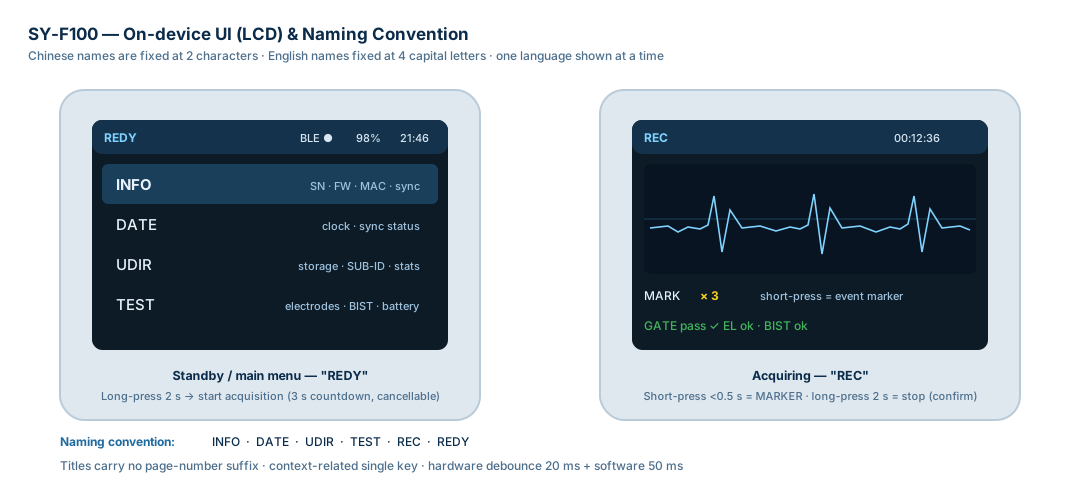
LCD 界面图:待机主菜单(REDY)与采集中界面(REC)。界面命名规范:中文固定 2 字、英文固定 4 字母。 LCD UI mockup: standby main menu (REDY) and acquiring screen (REC). Naming convention: Chinese fixed at 2 characters, English fixed at 4 capital letters.
时长分层Press-duration layers
| 手势Gesture | 时长Duration | 反馈Feedback |
|---|---|---|
| 短按Short press | < 0.5 s | 即时响应;消抖硬件 20 ms + 软件 50 msImmediate; debounce 20 ms HW + 50 ms SW |
| 长按Long press | ≥ 2 s | 底部黄色进度条走满才触发,提前松开取消Yellow progress bar must complete; release cancels |
| 超长按Extra-long press | ≥ 5 s | 仅用于解锁屏幕Screen unlock only |
界面命名规范UI naming convention
中文固定 2 个汉字,英文固定 4 个大写字母;中英二选一显示,标题栏不带页码后缀。 Chinese names are exactly two characters, English names exactly four uppercase letters; only one language shows at a time, and title bars carry no page-number suffix.
| 界面Screen | 中文ZH | 英文EN |
|---|---|---|
| 设备页Device info | 设备 | INFO |
| 日期页Date & time | 日期 | DATE |
| U 盘页Storage | U盘 | UDIR |
| 自检页Self-test | 自检 | TEST |
| 采集界面Acquiring | 采集 | REC |
| 启动倒计时Ready countdown | 启动 | REDY |
界面语言由单条命令全局切换(写入 Flash 永久保存),不占用主菜单项。 Interface language switches globally via a single command (persisted to Flash) and consumes no main-menu item.
UART 命令接口(新增,不改动原有命令集) UART command interface (additive — existing command set unchanged)
| 命令Command | 功能Function | 回显Response |
|---|---|---|
| MA1 / MA2 | 全局语言切换:中文 / English(写 Flash 永久保存)Global language switch: Chinese / English (persisted to Flash) | OK Lang: CN / EN |
| MN1 – MN4 | 设备页 1–4(设备 / 日期 / U盘 / 自检)Info pages 1–4 (INFO / DATE / UDIR / TEST) | OK Info:1 SN=… FW=… |
| MT + 14 位digits | 时间同步,例 MT20261001143500Time sync, e.g. MT20261001143500 | OK Sync:2026-10-01 14:35:00 |
| MS + 编号ID | 设置受试者编号(仅蓝牙可设)Set subject ID (BLE only) | OK SubID:S005 |
| MK1 / MK0 | 屏幕锁定 / 解锁Screen lock / unlock | OK Lock:on / off |
| MR1 | 远程事件标记(等同采集短按)Remote event marker (equals short press in session) | OK Marker:01 t=+123.4s |
| MU + SN | 出厂写入序列号(工厂模式,写后永久锁定)Factory serial-number write (factory mode, permanently locked afterwards) | OK SN:… (locked) |
05 振动感知阈值(VPT)测试能力 (option) Vibration Perception Threshold (VPT) Capability(option)
线性谐振执行器 · 30–80 Hz 与 250–500 Hz 双频段 Linear resonant actuator · 30–80 Hz and 250–500 Hz bands为什么 VPT 需要独立通道Why VPT needs its own channel
VPT 评估的是大纤维(Aβ 有髓纤维)功能,与 EDA 反映的小纤维 / 汗腺通路完全不同,两者互不替代。指端是国际公认的 VPT 标准测试位点,本设备在指套内集成振动执行器,无需外接任何设备即可完成阈值测试。 VPT assesses large-fibre (myelinated Aβ) function, a pathway entirely distinct from the small-fibre / sudomotor signal that EDA reflects. Neither substitutes for the other. The fingertip is the internationally accepted VPT reference site, and the sleeve integrates the actuator so threshold testing needs no external equipment.
振动输出规范Vibration output specification
- 执行器类型Actuator type线性谐振执行器Linear resonant actuator
- 低频段Low band30 – 80 Hz
- 高频段High band250 – 500 Hz
- 输出性质Output nature标准化梯度振动刺激,仅作激励源Standardised graded vibration, excitation source only
- 患者响应Patient response指套单按键(毫秒级时间戳落盘)On-sleeve single key (ms-resolution timestamp logged)
- 质控Quality control响应时刻同步记录电极接触质量Electrode contact quality logged with each response
06 电气安全、电磁兼容与环境试验 Electrical Safety, EMC & Environmental Testing
电气安全Electrical safety
- 工作电压Operating voltageDC 3.7 V
- 绝缘电阻Insulation resistance≥ 100 MΩ
- 介电强度Dielectric strength500 VAC
- 电池保护Battery protection过充/过放/短路/过热 四重Quad: over-charge/discharge/short/heat
- 患者漏电流Patient leakageBF 型应用部分type applied part
GB 9706.1-2020
电磁兼容EMC
- 传导 / 辐射发射Conducted / radiated emission1 组 B 类限值Group 1, Class B
- ESD±8 kV 空气air / ±4 kV 接触contact
- 射频辐射抗扰RF radiated immunity3 V/m, 80 MHz – 2.7 GHz
- 射频传导抗扰RF conducted immunity3 V, 150 kHz – 80 MHz
- EFT / 浪涌EFT / surge±2 kV / ±1 kV
YY 9706.102-2021(2023-05-01 起强制实施mandatory since 2023-05-01)
环境与机械Environmental & mechanical
- 工作温度Operating temp.10 – 40 ℃
- 存储温度Storage temp.−20 – 55 ℃
- 工作湿度Humidity30 – 75 %
- 振动试验Vibration10 – 150 Hz 正弦sine
- 跌落试验Drop test1.2 m 水泥地面concrete
- 充电接口耐久Connector durability500 次插拔cycles
GB/T 14710-2009
07 规范性引用标准Normative Standards Referenced
可直接用于伦理提交与方案论证 Directly usable in ethics submissions and grant justification| # | 标准编号Standard | 名称Title | 适用范围Scope |
|---|---|---|---|
| 1 | GB 9706.1-2020 | 医用电气设备 第 1 部分:基本安全和基本性能通用要求Medical electrical equipment — Part 1: General requirements for basic safety and essential performance | 整机电气安全Device electrical safety |
| 2 | YY 9706.102-2021 | 医用电气设备 第 1-2 部分:电磁兼容 要求和试验Medical electrical equipment — Part 1-2: EMC requirements and tests | 整机电磁兼容Device EMC |
| 3 | GB/T 16886.1-2022 | 医疗器械生物学评价 第 1 部分Biological evaluation of medical devices — Part 1 | 电极/指套材料生物相容性Electrode/sleeve biocompatibility |
| 4 | GB/T 16886.5-2017 | 生物学评价 第 5 部分:体外细胞毒性试验Biological evaluation — Part 5: In vitro cytotoxicity | 电极材料细胞毒性Electrode cytotoxicity |
| 5 | GB/T 16886.10-2017 | 生物学评价 第 10 部分:刺激与皮肤致敏Biological evaluation — Part 10: Irritation and skin sensitisation | 电极材料致敏与刺激Electrode sensitisation/irritation |
| 6 | YY 9706.247-2021 | 医用电气设备 第 2-47 部分:动态心电图系统专用要求Medical electrical equipment — Part 2-47: Ambulatory ECG systems | ECG 模块前端测试方法ECG front-end test methods |
| 7 | YY 9706.261-2023 | 医用电气设备 第 2-61 部分:脉搏血氧设备专用要求Medical electrical equipment — Part 2-61: Pulse oximeters | SpO₂ 测量专用标准SpO₂ measurement |
| 8 | ISO 20495:2018 | 传统医学 — 皮肤电阻测量设备Traditional Chinese medicine — Skin electrical resistance measurement devices | EDA 测量原理与性能测试框架EDA principle & performance test framework |
| 9 | GB/T 14710-2009 | 医用电器环境要求及试验方法Environmental requirements and test methods for medical electrical equipment | 环境试验Environmental testing |
| 10 | YY/T 0316-2016 | 医疗器械 风险管理对医疗器械的应用Medical devices — Application of risk management to medical devices | 风险管理Risk management |
08 预期用途与合规边界Intended Use & Regulatory Boundary
预期用途:Intended use: 用于医疗机构或家庭对患者进行无创心电信号(ECG)、脉搏血氧饱和度(SpO₂)、皮肤电导信号(EDA)的采集、显示、存储及传输。 Non-invasive acquisition, display, storage and transmission of ECG, SpO₂ and EDA signals for patients in clinical or home settings.
对科研团队的含义What this means for research teams
- 硬件层面完全开放:设备提供的是原始信号,不做任何"黑箱结论",你的算法可以完全接管后续处理。 Fully open at the hardware level: the device delivers raw signals with no black-box conclusions; your algorithms take over all downstream processing.
- 免临床路径:在中国,采集类器械的免临床论证链条清晰;如需在海外做研究性使用,可先用科研用途定位积累证据。 Streamlined clinical-exemption path: in China the justification chain for acquisition-only devices is well established; for overseas research use, the device can first be positioned as a research instrument to accumulate evidence.
- 宣称纪律:任何超出"采集、显示、存储、传输"的功能宣称都需要独立取证。这一点对论文写作同样适用——方法学中应描述为"信号采集设备"而非"评估工具"。 Claim discipline: any functionality beyond acquisition, display, storage and transmission requires separate certification. The same applies to manuscript writing — describe it in Methods as a signal-acquisition device, not as an assessment tool.
SY-F100 的数据如何输出How SY-F100 data comes out
四种帧型、通道注册表、META 元数据快照与 PC 端解析 API。 Four frame types, the channel registry, META snapshots and the PC-side parsing API.
查看数据格式 →View the data format →用这台设备能做什么研究What research this device enables
三硬件协同范式、数据质量门控、五个可对接的世界领先方向。 The three-hardware paradigm, data-quality gates, and five world-leading directions open to collaboration.
查看科研平台 →View the research platform →